
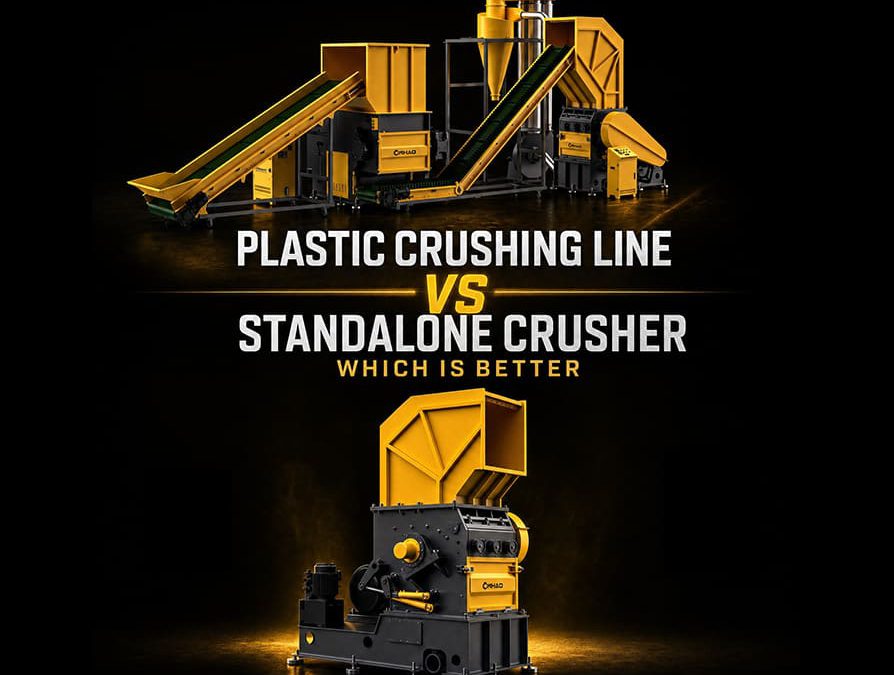
A standalone plastic crusher is designed only for reducing material size, while a plastic crushing line combines feeding, metal detection, conveying, crushing, and discharge into a complete processing system. For small-scale recycling operations, a standalone crusher may be sufficient. However, for continuous industrial recycling, a plastic crushing line offers higher throughput, lower labor requirements, better equipment protection, and more stable output quality. The best choice depends on material type, production capacity, automation requirements, and long-term operating costs.
Εισαγωγή
Plastic size reduction is a critical step in modern recycling systems. Whether processing PET bottles, HDPE containers, PP woven bags, plastic pipes, or rigid plastic lumps, recyclers must choose equipment that matches production goals.
Two common options are standalone crushers and integrated plastic crushing lines. Although both perform material reduction, their functionality and operational efficiency differ significantly.
What Is the Difference Between a Plastic Crushing Line and a Standalone Crusher?
A standalone crusher is a single machine, while a plastic crushing line is a complete automated processing system.
Standalone Crusher
A standalone crusher consists primarily of:
- Feeding hopper
- Rotor and knives
- Οθόνη
- Drive motor
- Discharge outlet
Its primary function is reducing plastic into smaller flakes or regrind.
Plastic Crushing Line
A plastic crushing line typically includes:
- Feeding conveyor
- Metal detector
- Belt conveyor
- Plastic crusher
- Discharge conveyor
- Collection system
- Electrical control cabinet
The entire process operates continuously with minimal manual handling.
Comparison Table
| Item | Standalone Crusher | Plastic Crushing Line |
| Αυτοματοποίηση | Low | Υψηλή |
| Feeding Method | Manual | Conveyor-fed |
| Metal Detection | Usually None | Integrated |
| Χωρητικότητα | Small to Medium | Medium to Large |
| Labor Requirement | Υψηλότερο | Κάτω |
| Equipment Protection | Περιορισμένη | Better |
| Material Flow | Batch Operation | Continuous Operation |
| Scalability | Περιορισμένη | Υψηλή |
How Does It Work?
Standalone Crusher Workflow
Συμπέρασμα
Material is manually fed into the crusher and discharged after size reduction.
Διαδικασία
- Material loading
- Σύνθλιψη
- Διαλογή
- Material discharge
- Συλλογή
The process often requires operators to handle materials between stages.
Plastic Crushing Line Workflow
Συμπέρασμα
The line automates feeding, inspection, crushing, and material transfer.
Process Steps
- Material feeding onto conveyor
- Metal detection
- Automatic feeding into crusher
- Size reduction
- Flake discharge
- Material collection or transfer to washing systems
This design minimizes interruptions and improves productivity.
Key Technical Comparison
Typical Specifications
| Παράμετρος | Standalone Crusher | Plastic Crushing Line |
| Χωρητικότητα | 300–1500 kg/h | 500–5000 kg/h |
| Ισχύς κινητήρα | 15–75 kW | 30–250 kW |
| Automation Level | Manual | Automatic |
| Labor Requirement | 1–3 Operators | 1 Operator |
| Metal Protection | Προαιρετικό | Standard |
| Integration with Washing Line | Περιορισμένη | Easy |
Actual values vary according to material type and machine configuration.
Benefits of a Plastic Crushing Line
Higher Throughput
Continuous feeding allows stable operation without frequent stops.
Industrial systems can process several tons of plastic waste per hour.
Better Equipment Protection
Integrated metal detectors identify ferrous contaminants before they enter the crusher.
This reduces blade damage and unplanned downtime.
Lower Labor Costs
Automatic conveying reduces manual material handling.
Fewer operators are required to maintain production.
Consistent Output Quality
Controlled feeding improves rotor loading stability.
This helps produce more uniform flake sizes.
Easier Integration
Plastic crushing lines can be connected directly to:
- Plastic washing lines
- PET bottle recycling systems
- Film recycling lines
- Granulation systems
This supports fully automated recycling operations.
Common Problems with Standalone Crushers
Frequent Feeding Interruptions
Manual feeding limits production efficiency.
Material flow may become inconsistent.
Higher Blade Wear
Unexpected metal contamination can damage knives and screens.
Maintenance costs increase over time.
Increased Labor Dependency
Operators must frequently load and transport materials.
Labor expenses become significant in large-scale facilities.
Production Bottlenecks
As recycling volumes grow, standalone crushers often struggle to meet throughput requirements.
Λύσεις
Install Conveyor Feeding Systems
Conveyors create continuous material flow and improve productivity.
Add Metal Detection Equipment
Metal detectors help prevent damage from bolts, screws, and metal fragments.
Upgrade to Integrated Crushing Lines
For facilities processing more than 1 ton/hour, automated crushing lines often provide better long-term efficiency.
Optimize Blade Configuration
Knife design should match material characteristics:
| Υλικό | Recommended Knife Type |
| Πλαστικά μπουκάλια | V-Type Rotor |
| HDPE Containers | Open Rotor |
| Πλαστικοί σωλήνες | Heavy-Duty Rotor |
| Πλαστικές μεμβράνες | Specialized Film Crusher |
ΣΥΧΝΈΣ ΕΡΩΤΉΣΕΙΣ
Is a plastic crushing line better than a standalone crusher?
For medium and large recycling facilities, yes. It provides higher automation, throughput, and operational efficiency.
When is a standalone crusher sufficient?
It is suitable for small recycling plants, workshops, and low-volume applications.
Why is a metal detector important?
It prevents metal contaminants from damaging blades, shafts, and bearings.
Can a crushing line process PET bottles?
Yes. PET bottles are among the most common materials processed by plastic crushing lines.
Can the crushing line connect to a washing system?
Yes. Most recycling plants integrate crushing lines directly with washing and drying systems.
What capacity should I choose?
Capacity selection depends on material density, daily throughput targets, and future expansion plans.
Συμπέρασμα
A standalone crusher and a plastic crushing line serve different production requirements. Standalone crushers are suitable for smaller operations with limited throughput needs. Plastic crushing lines offer automated feeding, metal detection, continuous operation, and higher productivity. For growing recycling facilities, integrated crushing lines often deliver lower operating costs and improved material processing efficiency.
Streamline Eco Tech Λύση
Streamline Eco Tech provides customized plastic crushing solutions for PET bottles, rigid plastics, plastic films, pipes, woven bags, and industrial plastic waste. By integrating conveyors, metal detection systems, crushers, and downstream recycling equipment, Streamline Eco Tech helps recycling facilities improve productivity, protect equipment, and support circular economy goals.