
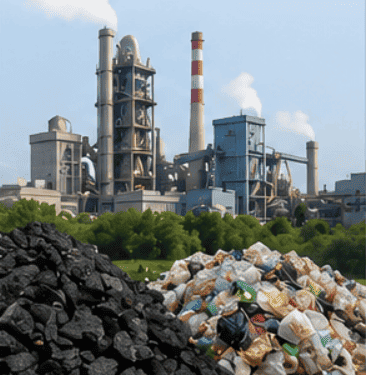
RDF (Refuse Derived Fuel) and coal are both widely used as industrial fuels, but they differ significantly in source, environmental impact, calorific value, and sustainability. Coal generally offers a higher and more stable heating value, while RDF provides lower carbon emissions, reduces landfill waste, and supports circular economy goals. For cement plants, power generation facilities, and industrial boilers seeking alternative fuels, RDF can partially replace coal and help reduce fuel costs and environmental impact.
Introduction
Industrial facilities worldwide are under increasing pressure to reduce carbon emissions and improve resource efficiency.
As a result, many industries are evaluating alternative fuels that can replace traditional fossil fuels such as coal.
Among these alternatives, RDF has emerged as a practical solution for waste-to-energy applications.
What Is RDF Fuel?
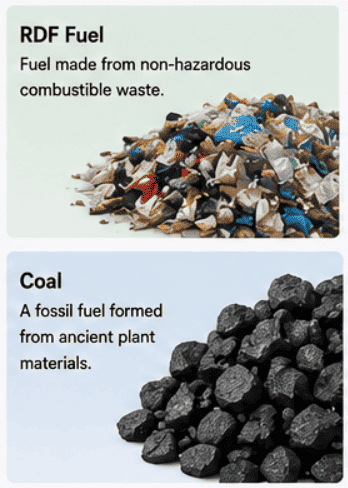
RDF is a fuel produced from non-hazardous combustible waste materials that would otherwise be sent to landfills.
Typical RDF Feedstock
Common RDF materials include:
- Waste plastics
- Waste paper
- Cardboard
- Textiles
- Packaging waste
- Municipal solid waste (MSW)
What Is Coal?
Coal is a fossil fuel formed from ancient plant materials over millions of years.
It remains one of the most widely used fuels for:
- Power generation
- Cement production
- Industrial heating
- Metallurgical processes
How Does RDF Production Work?
RDF is produced through sorting, shredding, screening, drying, and quality control processes.
RDF Production Process
Step 1: Waste Collection
Combustible waste is collected from municipal and industrial sources.
Step 2: Sorting
Recyclable and non-combustible materials are removed.
Step 3: Shredding
Waste is reduced to a uniform particle size using industrial shredders.
Step 4: Screening
Fine contaminants and inert materials are separated.
Step 5: Drying
Moisture content is reduced to improve fuel quality.
Step 6: RDF Production
Processed material becomes RDF suitable for industrial combustion.
Key Technical Parameters
RDF vs Coal Comparison
| Parameter | RDF Fuel | Coal |
| Source | Waste Materials | Fossil Fuel |
| Calorific Value | 12–25 MJ/kg | 20–35 MJ/kg |
| Moisture Content | 10–25% | 5–15% |
| Ash Content | 5–20% | 5–30% |
| Carbon Footprint | Lower | Higher |
| Renewable Content | Partial | None |
| Landfill Diversion | Yes | No |
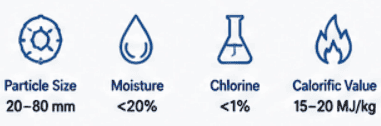
Typical RDF Quality Indicators
| Parameter | Typical Range |
| Particle Size | 20–80 mm |
| Moisture Content | <20% |
| Chlorine Content | <1% |
| Calorific Value | 15–20 MJ/kg |
Benefits of PET Recycling
1. Resource Conservation
Reduces dependence on virgin plastics.
2. Lower Carbon Emissions
Consumes less energy than virgin PET production.
3. Reduced Landfill Waste
Diverts plastic waste from disposal sites.
4. Circular Economy Support
Enables repeated material reuse.
5. Economic Value Creation
Creates revenue from recovered materials.
Benefits of RDF Fuel
1. Reduced Landfill Waste
RDF converts combustible waste into a valuable energy source.
2. Lower Carbon Emissions
RDF generally produces lower net greenhouse gas emissions than coal.
3. Supports Circular Economy
Waste materials are recovered and utilized rather than discarded.
4. Alternative Fuel Supply
Helps reduce dependence on fossil fuels.
5. Potential Cost Savings
Fuel costs may be reduced depending on local waste availability.
Common Problems
Inconsistent Fuel Quality
RDF composition can vary depending on waste sources.
High Moisture Content
Excess moisture reduces calorific value.
Chlorine Contamination
PVC contamination may increase chlorine levels.
Storage Challenges
Improper storage may lead to moisture absorption.
Solutions
Improve Waste Sorting
Remove non-combustible and unsuitable materials before processing.
Install Efficient Shredding Systems
Produce uniform RDF particle sizes.
Optimize Drying Processes
Reduce moisture content before storage.
Implement Quality Control
Regularly test:
- Moisture
- Calorific value
- Ash content
- Chlorine content
RDF Fuel vs Coal: Which Is Better?
For Energy Density
Winner: Coal
Coal generally provides a higher and more stable calorific value.
For Environmental Performance
Winner: RDF
RDF helps reduce landfill waste and lower carbon emissions.
For Sustainability
Winner: RDF
RDF supports waste recovery and circular economy objectives.
For Fuel Consistency
Winner: Coal
Coal quality is usually more predictable.
For Future Regulations
Winner: RDF
Many industries are increasing RDF usage to meet sustainability targets.
FAQ
What does RDF stand for?
RDF stands for Refuse Derived Fuel.
Can RDF completely replace coal?
In some applications, RDF can partially or substantially replace coal, depending on system design.
What industries use RDF?
Cement plants, power plants, industrial boilers, and waste-to-energy facilities.
Is RDF renewable?
RDF contains both renewable and non-renewable components.
What is the calorific value of RDF?
Typically between 12 and 25 MJ/kg.
Does RDF reduce carbon emissions?
Generally yes, compared with traditional fossil fuels.
Why is shredding important in RDF production?
Shredding creates uniform particle sizes and improves combustion efficiency.
Päätelmä
Coal continues to provide high energy density and stable fuel performance, but RDF offers significant environmental and sustainability advantages. For industries seeking to reduce landfill waste, lower carbon emissions, and improve resource recovery, RDF is becoming an increasingly important alternative fuel. The best solution often involves a combination of RDF and conventional fuels based on operational requirements.
Streamline Eco Tech Ratkaisu
Streamline Eco Tech provides complete RDF production solutions for waste-to-energy and alternative fuel applications.
Our systems include:
- Double Shaft Shredders
- RDF Processing Lines
- Waste Sorting Systems
- Screening Equipment
- Drying Solutions
Related Resources:
https://slecotech.com/double-shaft-shredder/
By integrating advanced shredding and RDF preparation technologies, Streamline Eco Tech helps customers convert waste into valuable fuel while supporting sustainability goals.