
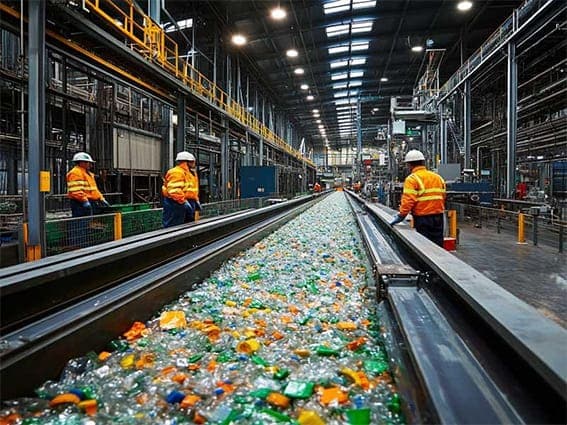
The plastic recycling industry is undergoing its fastest transformation in decades. The global recycled plastics market — valued at USD 60–86 billion in 2025 — is projected to reach USD 126–190 billion by 2034–2035, growing at a CAGR of 8–10.5%. For equipment buyers, this means new regulations, new technologies, and new competitive pressures. This article covers the five trends that matter most when you are investing in recycling equipment in 2026.
Trend 1: Regulatory Mandates Are Forcing Investment — Not Just Encouraging It
The biggest driver in 2026 is not consumer preference or corporate sustainability pledges — it is mandatory recycled content requirements with legal deadlines and financial penalties.
| Regulation | Region | Key Requirement | Deadline | Impact on Equipment Buyers |
|---|---|---|---|---|
| EU PPWR (Packaging & Packaging Waste Regulation) | European Union | 25–30% PCR content in plastic packaging; mandatory separate collection for flexible films | 2030 | Drives demand for food-grade washing lines and hot wash systems capable of producing ≤50 ppm purity |
| EPR Laws (Extended Producer Responsibility) | Multiple US states (CA, CO, ME, OR) | Producers fund collection and recycling; recycled content minimums for beverage containers | 2025–2030 (varies by state) | Increases post-consumer bottle supply; requires washing lines with sink-float and optical sorting |
| India PWM Rules (Plastic Waste Management) | India | Mandatory EPR for producers, importers, and brand owners; minimum recycled content thresholds | Phased through 2028 | Expands demand for mid-capacity washing and pelletizing lines (500–1,500 kg/h) |
| UN Global Plastics Treaty | Global (175+ nations) | Legally binding instrument to end plastic pollution; expected to mandate recycling targets | Negotiations ongoing; likely implementation 2027+ | Long-term demand signal for all recycling equipment categories |
Buyer takeaway: If you are buying equipment today, spec it for regulatory compliance 3–5 years out. A cold-wash line that produces 98% purity may be viable now but will not meet 2030 food-grade PCR mandates. Build in hot wash, sink-float, and sorting capability from the start.
Trend 2: Chemical Recycling Is Growing — But Mechanical Recycling Still Dominates
Chemical recycling (pyrolysis, depolymerization, gasification, solvent-based purification) attracted heavy investment in 2024–2026, but it complements rather than replaces mechanical recycling. Here is the reality for equipment buyers:
| Technology | 2026 Status | Best For | Limitations | Capital Cost (Indicative) |
|---|---|---|---|---|
| Mechanical Recycling (shred + wash + pelletize) | ✅ Mature — 90%+ of global recycled plastic output | PET, HDPE, PP, LDPE film, post-industrial scrap | Cannot handle multilayer packaging, heavily contaminated or mixed streams; polymer degradation after multiple cycles | $150,000–$1,000,000+ |
| Pyrolysis | ⚠️ Scaling — modular, portable units emerging | Mixed polyolefins, film, non-recyclable packaging | High energy input; output is pyrolysis oil (not polymer); requires refining for chemical feedstock quality | $500,000–$5,000,000+ |
| Depolymerization | ⚠️ Early commercial — PET and PU focus | PET bottles and textiles, polyurethane foam | Feedstock-specific; PET enzymatic recycling still at pilot scale | $2,000,000–$10,000,000+ |
| Solvent-Based Purification | ⚠️ Emerging — near-virgin quality output | Food-grade PP, PE, and PS from post-consumer waste | Solvent recovery adds cost and complexity; limited to specific polymers | $3,000,000–$15,000,000+ |
Buyer takeaway: For 90% of recycling applications in 2026, mechanical recycling is the right investment. Chemical recycling is for the 10% of waste that mechanical cannot process — multilayer packaging, heavily contaminated streams, and applications requiring virgin-equivalent quality. Most recyclers should master mechanical first and add chemical as a premium bolt-on later.
Trend 3: AI and Automation Are No Longer Optional
Manual sorting is the bottleneck in most recycling plants. In 2026, AI-powered optical sorting and robotic picking systems have moved from experimental to standard equipment — and the ROI is compelling.
| Technology | Function | Throughput Gain | Purity Improvement | Payback Period |
|---|---|---|---|---|
| AI Optical Sorting (NIR + hyperspectral) | Identifies and ejects specific polymers, colors, and contaminants at conveyor speed | 20–40% throughput increase over manual sorting | 95% → 99%+ purity | 12–24 months |
| Robotic Picking Arms | Picks targeted objects from conveyor belt; 60–80 picks/min per arm | Replaces 2–3 manual sorters per arm | Consistent quality (eliminates human fatigue) | 18–30 months |
| Real-Time Monitoring (AI cameras on shredders/washers) | Detects material composition, contamination spikes, and equipment anomalies | Reduces downtime by 20–35% (predictive maintenance) | Enables real-time process adjustment | 6–12 months |
| Blockchain Traceability | Verifies recycled content origin and percentage for regulatory compliance | N/A (compliance, not throughput) | Enables premium pricing for certified PCR | Varies — often required by buyer contracts |
Buyer takeaway: When buying a new line in 2026, specify equipment that is AI-ready — meaning it has sensor ports, API connectivity, and modular conveyor sections where optical sorters or robotic pickers can be retrofitted. A line without AI integration capability will be obsolete within 3–5 years.
Trend 4: High-Capacity Integrated Lines Are the New Standard
The economics of plastic recycling have shifted. Smaller lines (300–500 kg/h) still work for niche applications and in-house post-industrial recovery, but the investment focus in 2025–2026 is on high-capacity integrated systems (1,500–3,500 kg/h). Here is why:
| Factor | Small Line (300–500 kg/h) | Large Line (1,500–3,500 kg/h) |
|---|---|---|
| Capital per kg/h capacity | $500–$800/kg/h | $250–$400/kg/h |
| Labor per ton | 3–5 operators → 0.6–1.0 man-hours/ton | 4–6 operators → 0.15–0.25 man-hours/ton |
| Energy per ton | 30–50 kWh/ton | 18–30 kWh/ton (with heat recovery) |
| Water consumption | 2–4 m³/ton | 0.5–1.5 m³/ton (with closed-loop treatment) |
| Output consistency | Batch-dependent | Continuous, automated quality control |
| Breakeven scale | 500–1,000 tons/year | 5,000–15,000 tons/year |
The key innovation enabling large lines is modular design. Rather than one monolithic machine, modern high-capacity lines are built from standardized modules — pre-shredder, hot washer, sink-float, dryer, pelletizer — that can be reconfigured for different feedstocks. A line processing PET bottles this month can switch to HDPE containers next month by swapping the sink-float configuration and adjusting washer chemistry.
Buyer takeaway: If your feedstock supply supports 5,000+ tons/year, invest in a 1,500–3,500 kg/h line with modular architecture. The per-ton economics are 40–60% better than a small line, and the modular design protects against feedstock changes.
Trend 5: Water and Energy Efficiency Define Profitability
In 2026, the cost difference between a standard washing line and an efficient one is no longer marginal — it is the difference between profit and loss. Water treatment and energy recovery systems have moved from optional extras to essential components:
| System | Standard Line | Efficient Line | Annual Savings (2,000 kg/h, 6,000 hrs/yr) |
|---|---|---|---|
| Water Recirculation | Single-pass: 3 m³/ton fresh water | Closed-loop with UF/RO: 0.3 m³/ton | 32,400 m³ water/year ≈ $15,000–$50,000 depending on local water cost |
| Heat Recovery | Hot wash water drained to sewer | Heat exchanger recovers 60–70% of thermal energy | 15–25% electricity reduction ≈ $20,000–$60,000/year |
| Wastewater Treatment | Discharge to municipal sewer (if permitted) | On-site sedimentation + chemical treatment + UF | Avoids $10,000–$100,000+/year in discharge fees and fines |
| Microplastic Filtration | None — microplastics enter wastewater | Advanced filtration captures 88–95% of particles >10 μm | Regulatory compliance; avoids future liability |
Buyer takeaway: Budget 15–25% of your total line investment for water treatment and energy recovery. In most regions, the payback period is under 18 months from water, energy, and compliance savings alone.
Regional Hotspots: Where the Growth Is
| Region | Growth Driver | Equipment Demand | Key Consideration |
|---|---|---|---|
| Europe | EU PPWR mandates, brand PCR commitments, high landfill costs | Food-grade PET and HDPE washing lines, optical sorting, blockchain traceability | Highest quality requirements; expect to invest in hot wash + sorting |
| North America | State-level EPR laws, brand voluntary commitments, federal infrastructure funding | Mid-to-large capacity lines (1,500–3,500 kg/h) for PET and HDPE | Feedstock inconsistency is the #1 challenge; invest in flexible, contamination-tolerant pre-processing |
| Southeast Asia | Post-National Sword import restrictions, growing domestic waste generation | PE film washing lines, mixed plastic sorting and washing | High contamination (20–40% soil in agricultural film); need robust pre-washing and multi-stage flotation |
| India | PWM Rules, rapid urbanization, informal sector formalization | Mid-capacity washing lines (500–1,500 kg/h) for PET, HDPE, PP | Price-sensitive market; modular, scalable designs preferred |
| Middle East & Africa | Diversification from virgin production, waste infrastructure development | Complete turnkey systems with training and support | Water scarcity makes closed-loop treatment essential; dust and sand require heavy-duty pre-washing |
| Latin America | Import substitution, agricultural film recycling, landfill reduction | PE/PP washing and pelletizing for agricultural and post-industrial waste | Lower labor costs reduce automation ROI; prioritize throughput over robotic sorting |
What This Means for Your Equipment Purchase in 2026
If you are buying now, here are the five non-negotiable features:
- Modular architecture — The ability to add stages (hot wash, optical sorting, second pelletizer) without replacing the entire line. Feedstock availability changes; your line should adapt.
- AI-ready connectivity — Sensor ports, API endpoints, and conveyor sections designed for optical sorter or robotic picker integration. Do not buy a line that is locked out of automation upgrades.
- Closed-loop water treatment — Built-in water recirculation with ultrafiltration. If your supplier does not offer it as standard, find one that does. Water costs and discharge regulations only move in one direction.
- Hot wash capability — Even if you do not need food-grade output today, the cost of adding hot wash later is 2–3× the cost of including it upfront. Spec the heat exchanger and insulated tanks now; you can operate cold when hot is not needed.
- Regulatory headroom — Design your line to meet 2030 PCR content standards (25–30% minimum), not 2026 requirements. The line you install today will still be running in 2030.
FAQ
Is mechanical recycling still worth investing in with all the hype around chemical recycling?
Yes — absolutely. Mechanical recycling produces over 90% of the world’s recycled plastic and will continue to do so through 2035. Chemical recycling addresses the 10% of waste that mechanical cannot handle (multilayer packaging, heavily mixed streams). For most investors, the right strategy is: build a strong mechanical recycling line first, then evaluate chemical recycling as a bolt-on for the residual fraction.
How much does a modern recycling line cost in 2026?
A basic clean post-industrial line (shredder + crusher + cold wash) runs $80,000–$150,000. A mid-capacity post-consumer line with hot wash, sink-float, and drying (1,000–2,000 kg/h) costs $200,000–$400,000. A fully integrated high-capacity line with AI sorting, water treatment, and pelletizing (2,000–3,500 kg/h) ranges from $500,000 to over $1,000,000. Budget an additional 15–25% for water treatment and energy recovery systems.
What is the most important regulatory change affecting recycling equipment buyers?
The EU Packaging and Packaging Waste Regulation (PPWR) mandating 25–30% post-consumer recycled content in plastic packaging by 2030. This single regulation creates legally enforceable demand for high-purity recycled plastic across the world’s largest market. Equipment buyers should spec their lines to meet PPWR-grade output — even if selling outside Europe — because similar mandates are being drafted in other regions.
Should I buy a small line now or wait until I can afford a larger one?
If your feedstock supply is under 1,000 tons/year, a small line (300–500 kg/h) is appropriate. But if you have or can secure 3,000+ tons/year, the per-ton economics of a 1,500+ kg/h line are 40–60% better. Consider a modular approach: buy a core line (shredder + wash + dryer) at medium capacity and add sorting, pelletizing, and water treatment modules as volume grows.
How long will a recycling line remain competitive before it needs upgrading?
A well-specified mechanical recycling line installed in 2026 should remain competitive for 8–12 years, provided it has modular architecture and AI-ready connectivity. Lines without these features risk obsolescence within 5 years as regulations tighten and automated competitors drive down processing costs.
Streamline Eco Tech: Future-Ready Recycling Equipment
Streamline Eco Tech designs and manufactures recycling equipment with the 2026 reality in mind: modular washing lines that scale from 500 to 3,500 kg/h, closed-loop water treatment systems that reduce consumption by 85–92%, hot wash and sink-float modules that meet PPWR-grade purity requirements, and AI-ready conveyor and sorting interfaces that accept optical sorters and robotic pickers as plug-in modules.
We do not sell a machine — we configure a system around your material, your volume, and your market’s regulatory trajectory. Send us your material sample and throughput target. We will recommend a line that works today and remains competitive through 2030 and beyond.
Frequently Asked Questions
What is the difference between PPWR and EPR?
PPWR (Packaging and Packaging Waste Regulation) is an EU law that sets mandatory recycled content percentages for plastic packaging — 25–30% by 2030. EPR (Extended Producer Responsibility) is a policy framework where producers pay for the collection and recycling of their packaging. EPR funds the system; PPWR sets the quality targets. Both drive demand for high-purity recycled plastic and the washing/sorting equipment to produce it.
Do I need AI sorting on my line?
Not on day one — but your line should be designed to accept it. AI optical sorting adds $50,000–$150,000 to line cost but improves output purity from ~95% to 99%+ and increases throughput by 20–40%. If your target market requires ≤50 ppm PVC or food-grade certification, AI sorting is effectively required. For lower-purity applications (construction, agriculture), manual or basic NIR sorting may suffice.
How does Streamline Eco Tech handle water treatment?
We integrate closed-loop water treatment as a standard module in all washing lines — not as an optional extra. Our systems combine sedimentation, chemical dosing, ultrafiltration, and optional reverse osmosis to achieve 85–92% water recirculation. This reduces fresh water consumption, eliminates most wastewater discharge, and ensures compliance with local environmental regulations.