

What Is a Pipe Shredder?
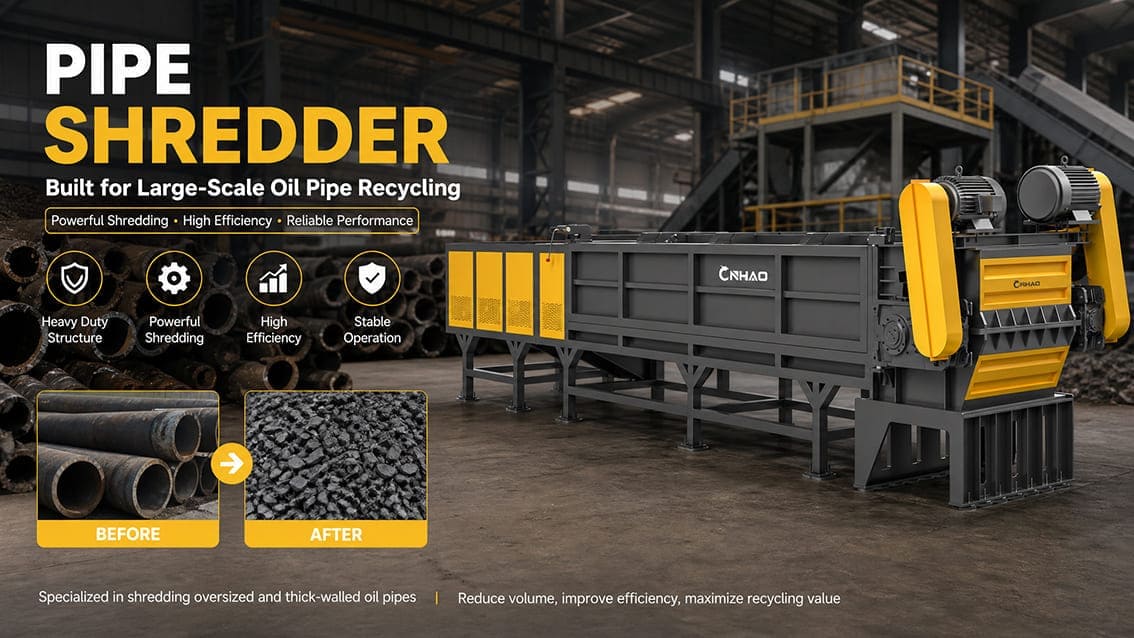
A Pipe Shredder is a recycling machine designed to reduce long and bulky plastic pipes into smaller pieces before granulation, washing, or reprocessing.
について P Series Pipe Shredder is specifically engineered for oversized plastic pipes that are difficult to process using conventional shredders. It is commonly used for HDPE, PVC, PP, PPR, PE, and large industrial pipe waste.
Why Are Large Plastic Pipes Difficult to Recycle?
Large-diameter pipes present unique challenges during recycling.
よくある課題
- Lengths exceeding 3–6 meters
- Diameters from 200 mm to over 1,200 mm
- Thick wall structures
- High material toughness
- Difficult manual handling and feeding
Without proper pre-shredding, these materials can overload downstream crushers and increase operational costs.
How Does the P Series Pipe Shredder Work?
The P Series Pipe Shredder is designed for continuous feeding of long pipes without extensive pre-cutting.
プロセスフロー
- Pipe Loading
- Hydraulic Feeding
- Pipe Shredding
- サイズ縮小
- Conveyor Discharge
- Secondary Crushing or Granulation
主要構成要素
| コンポーネント | 機能 |
| 油圧ラム | Pushes pipes into the rotor |
| High-Torque Rotor | Performs primary shredding |
| Fixed & Rotary Knives | Material cutting |
| Screen System | Controls output size |
| PLC Control System | Automated operation |
代表的な加工材料
The P Series Pipe Shredder is suitable for:
- HDPEパイプ
- PVCパイプ
- PPパイプ
- PPR pipes
- PE water pipes
- Corrugated pipes
- Plastic pipe production scrap
- Municipal pipe waste
技術パラメーター
Actual specifications vary according to project requirements.
| パラメータ | 代表的な範囲 |
| Pipe Diameter | 200–1,200 mm |
| Rotor Diameter | 500–800 mm |
| モーター出力 | 55–160 kW |
| スループット | 500–5,000 kg/h |
| 出力サイズ | 40–120 mm |
Benefits of Using a Pipe Shredder
1. Handles Oversized Pipes
The machine can process large pipes that cannot be fed directly into standard crushers.
2. Reduces Transportation and Storage Costs
Shredded material occupies significantly less volume than whole pipes.
3. Improves Downstream Efficiency
Uniform shredded pieces improve feeding consistency for crushers, washing lines, and extrusion systems.
4. Protects Secondary Equipment
Pre-shredding reduces impact loads and minimizes wear on granulators and crushers.
5. Supports Circular Economy Goals
Recovered plastic materials can be reintroduced into manufacturing applications.
Pipe Shredder vs Traditional Crusher
| 品目 | パイプシュレッダー | Traditional Crusher |
| Long Pipe Processing | 素晴らしい | 限定 |
| Large Diameter Handling | 素晴らしい | Difficult |
| Feeding Stability | 高い | ミディアム |
| Energy Efficiency | 高い | ミディアム |
| Equipment Protection | 高い | 低 |

Common Problems in Pipe Recycling
Problem 1: Feeding Large Pipes
Oversized pipes may not fit conventional crusher inlets.
Problem 2: Rotor Wear
Contaminated pipes may contain sand, stones, or metal particles.
Problem 3: Low Throughput
Manual pipe cutting increases labor and processing time.
ソリューション
Use Hydraulic Feeding Systems
Hydraulic feeding improves safety and feeding consistency.
Install Metal Detection Equipment
Metal detectors help prevent damage from embedded metal contaminants.
Optimize Shredding and Crushing Stages
Combining shredders with downstream crushers improves overall plant efficiency.
よくある質問
Can the P Series shred HDPE pipes?
Yes. HDPE pressure pipes are among the most common applications.
Can it process PVC pipes?
Yes. Both rigid PVC and large-diameter PVC pipes can be shredded.
Is pre-cutting required?
In many cases, long pipes can be fed directly into the machine, reducing labor requirements.
What is the typical output size?
Most systems produce shredded pieces between 40–120 mm before secondary processing.
ストリームライン・エコ・テック・ソリューション
Streamline Eco Tech provides recycling solutions for plastic pipes, rigid plastics, PET bottles, films, woven bags, and industrial plastic waste.
Our pipe recycling systems integrate Pipe Shredders, conveyors, metal separation equipment, crushers, washing systems, and pelletizing lines to improve recycling efficiency and material recovery while supporting circular economy objectives.
よくある質問
Why use a dedicated pipe shredder?
Long pipes roll and bridge in a standard hopper. A pipe shredder’s horizontal V-channel and hydraulic pusher hold and feed pipe safely and continuously.
What pipe diameters can a pipe shredder handle?
It is configured to your extrusion range; the cradle and rotor width are matched to the longest, widest pipe you run. Share your size range for the right build.
Can a pipe shredder recover extrusion offcuts?
はい。端材、加工くず、および無欠陥のプロファイル材は理想的な原料であり、再粉砕材としてそのまま製造工程に再投入されます。