
Most buyers start with the same question.
“I need to turn big scrap into small regrind. Do I buy a shredder and a crusher separately, or get one of those all-in-one machines?”
Salesmen love this question. The ones selling separate machines will tell you modular is more flexible. The ones selling integrated units will tell you one machine is cheaper to run. Both are right. Both are wrong. Depends on what you’re feeding, how much floor you have, and who’s running the shift.
Here’s the decision, laid out without the sales pitch.
What Each Setup Actually Looks Like
Two machines in series. A shredder sits upstream. Takes the big stuff — purge lumps, pipe cutoffs, whole parts — and chews it down to 30 to 50 mm flakes. A conveyor moves those flakes to a granulator. The granulator takes it to final regrind, usually 8 to 12 mm. Two motors. Two control panels. Two maintenance schedules. One conveyor between them.
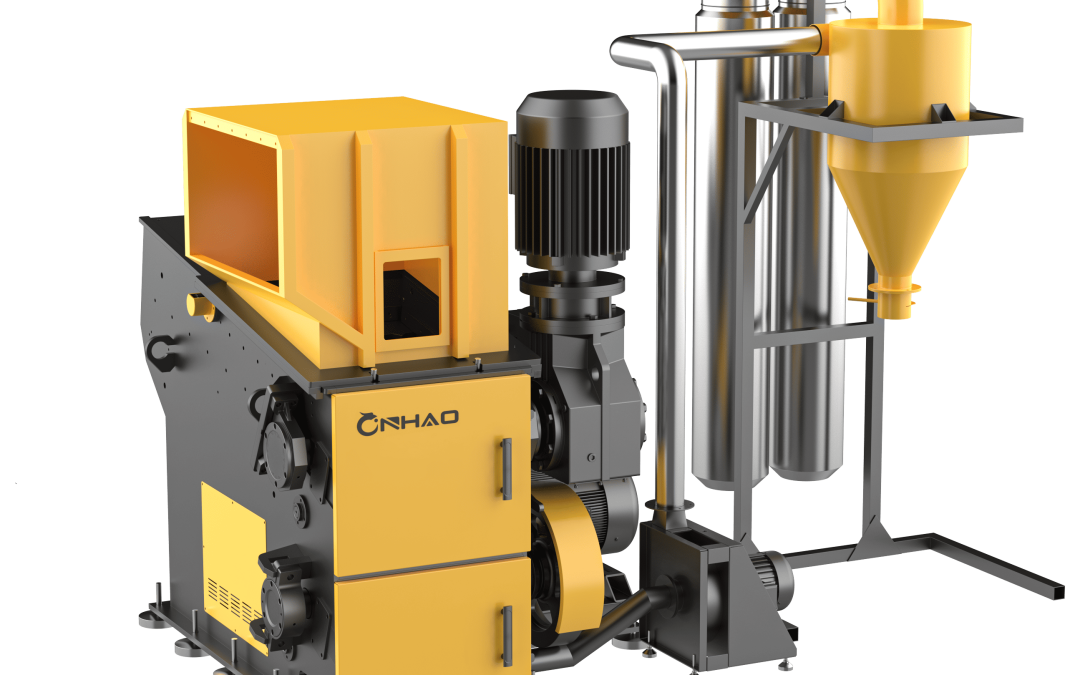
One integrated machine. Shredding and crushing happen inside the same housing. Material drops from the shredder stage directly into the crusher stage. No conveyor. One control panel. One maintenance schedule. One footprint.
That’s the simple version. Now the parts nobody tells you until month three.
Where Two Separate Machines Win
Your throughputs don’t match
Say your shredder does 800 kg an hour but your granulator does 400. With separate machines, you shred a batch, stockpile the flakes, and feed the granulator at its own pace. The shredder runs four hours. The granulator runs eight. You’re not paying to spin both rotors all day.
With an integrated unit, both stages run whenever the machine runs. If the crusher stage is the bottleneck, the shredder stage idles at partial load. You paid for shredder capacity you’re not using.
You process wildly different materials
Monday is PP purge lumps. Tuesday is glass-filled nylon. Wednesday is film scrap. With separate machines, you can swap the granulator screen between materials. Swap the shredder screen too if needed. Each machine is tuned to what’s coming in.
An integrated unit has one screen setup for both stages. Change it and you change the whole system. Not the end of the world, but less flexible. If your material mix changes daily, separate machines adapt faster.
One machine goes down, the other still runs
Shredder bearings fail. Crusher knives chip. With two machines, you lose one stage, not both. You can stockpile shredded flake while the granulator is down. Or buy pre-shredded material while the shredder is being fixed. With an integrated unit, any major failure on either stage stops the whole line.
You already own one of them
Plenty of plants already have a granulator. Adding a shredder upstream is cheaper than replacing the whole setup with an integrated machine. If your existing granulator is paid for and working, don’t replace it. Add to it.
Where an Integrated Machine Wins
Floor space is tight
Two machines plus a conveyor eat floor. A shredder, a granulator, and the belt between them can easily take 8 to 10 meters of linear floor. An integrated unit does the same job in 4 to 5 meters. In a factory where every square meter costs rent, that difference is real.
We’ve had customers who literally couldn’t fit two machines. The integrated unit was the only option that fit the space. Wasn’t a choice. Was geometry.
You don’t have two operators
Two machines means two feed points to monitor, two discharge points to check, and a conveyor that can jam, drift, or spill material between them. One attentive operator can manage it. But on a lean shift where the operator is also running an extruder and answering the phone, the conveyor is where things go wrong.
Integrated unit is one feed point. One discharge point. No transfer to monitor. One operator can genuinely run it alongside other equipment.
Dust control is simpler
A conveyor between shredder and granulator is an open transfer point. Material falls from one belt to another. Dust escapes. You can enclose it, add extraction, run negative pressure. But every enclosure and duct is something else to maintain.
Integrated units keep the transfer inside the housing. The dust collection system handles both stages with one pickup point. Less ductwork. Less leakage. Better air quality with less effort.
You’re buying everything new anyway
If you’re setting up a new recycling line from scratch and need both a shredder and a granulator, the math shifts. Two separate machines means two frames, two rotors, two sets of bearings, two motors, two control cabinets, and a conveyor. An integrated unit shares the frame, often shares part of the drive system, and eliminates the conveyor entirely.
The upfront cost of an integrated unit is typically 20 to 30 percent less than buying equivalent separate machines plus a conveyor. Installation is cheaper too. One machine to position and level, one power drop, one dust extraction connection.
The Hidden Costs Nobody Quotes
Conveyors break
Between a shredder and a granulator, the conveyor is the weakest link. Material bridges at the transfer point. The belt tracks off. A stray piece of metal snags and tears the belt. Conveyor downtime is the number one reason separate-machine lines stop. Not the shredder, not the crusher. The stupid belt between them.
A new belt costs a few hundred bucks. The two hours of downtime while someone replaces it costs more. Do that three times a year and the conveyor has cost you more in lost production than the price difference between separate and integrated.
Stockpiling flakes sounds fine until it isn’t
The “flexibility” argument for separate machines — shred now, granulate later — assumes you have space to store intermediate flake. A day’s worth of shredded material from a mid-size line is a few cubic meters of fluffy, irregular flake. It doesn’t stack. It doesn’t pack efficiently. It blows around. It gets contaminated if it sits.
If you have the bin space and a clean area to store it, fine. Most plants don’t. They end up running both machines simultaneously anyway. Which negates the “run them independently” advantage.
Maintenance labor doubles
Two machines. Two grease schedules. Two sets of knives to rotate. Two sets of screens to check. Two motors to monitor. Two bearing replacement cycles. On paper it’s “more flexible.” On a Friday afternoon when both machines are due for knife rotation and the maintenance guy is already behind, it’s just twice the work.
Decision Table
| Your Situation | Separate Machines | Integrated Unit |
| Setting up a new line, buying everything new | Higher upfront cost, more floor space | Lower cost, faster install, smaller footprint |
| Already own a granulator, need primary shredding | Add a shredder. Don’t replace what works. | Overkill unless the granulator is end-of-life |
| Processing 3+ different materials daily | Easier to reconfigure each machine independently | Screen changes affect both stages |
| Floor space is limited | Might not fit at all | Only option in tight layouts |
| One operator running multiple machines | Conveyor monitoring adds workload | One feed, one discharge, less babysitting |
| Throughput mismatch between stages | Run shredder in batches, granulator continuous | Bottleneck stage determines whole line speed |
| High dust material (glass-filled, regrind) | Open transfer point needs serious dust control | Enclosed transfer, one extraction point |
| Need redundancy, can’t afford full stoppage | Lose one stage, the other still runs | Any major failure stops everything |
When to Ignore Everything Above
If you’re shredding material that doesn’t need secondary granulation — say you’re making coarse flake for a washing line that feeds a pelletizer, and the pelletizer handles 30 to 50 mm input fine — you don’t need two stages at all. One shredder with the right screen does the job. Don’t buy complexity you don’t need.
Same logic in reverse. If all your scrap is already under 50 mm — small sprues, runners, thin-wall parts — you might not need a shredder at all. A heavy-duty granulator with a large hopper handles it alone. The shredder becomes a very expensive conveyor.
How SLECOTECH Ships Both
We build separate shredders (S Series, D Series) and separate granulators (C Series). We also build the SC Series integrated shredder-crusher. We’re not married to one architecture. Which means when you ask us “which one should I buy,” the answer isn’t predetermined by what we happen to sell.
Send us what you’re feeding, your target output size, your floor layout, and how many people are on shift. We’ll tell you whether separate or integrated makes sense. If the answer is “neither, you need a single shredder with the right screen,” we’ll tell you that too.
常见问题
What’s the throughput difference between separate and integrated?
On equivalent motor sizes, throughput is similar. The difference isn’t in cutting capacity. It’s in uptime, changeover speed, and operator attention. Separate machines lose production time to conveyor issues and independent maintenance windows. Integrated units lose production time when either stage needs work. Over a year, integrated units typically run more hours because there’s no conveyor to fail.
Can I retrofit an existing granulator with a shredder to make a makeshift integrated unit?
You can position a shredder above a granulator and let material gravity-feed. Some plants do this. But the feed rates need to match precisely, the shredder discharge needs to align with the granulator hopper, and you need a control system that stops the shredder if the granulator jams. It works better than a conveyor in some cases and worse in others. Test the alignment before you weld anything.
Which setup is easier to move or reconfigure later?
Separate machines. You can rearrange them, move them to different lines, sell one and keep the other. An integrated unit is one piece. It goes where it goes. If your plant layout changes every few years, modular wins.
What about noise?
Integrated units are quieter overall because the transfer happens inside the housing. Separate machines with an open conveyor have two noise sources plus material rattling on the belt. Not a huge difference in decibels. But the integrated unit sounds like one machine. Separate sounds like two.
Is one more reliable than the other?
The shredder and crusher stages themselves have similar reliability in both configurations. Same rotors. Same knives. Same bearings. The reliability difference is the conveyor. Integrated eliminates a failure point. Whether that matters depends on how well your conveyor is designed and maintained.
更多问题
What if my scrap varies a lot in size? Some huge lumps, some small sprues.
Integrated handles this fine. The shredder stage takes the big stuff. Small pieces pass through the shredder quickly and drop to the crusher. The system self-regulates as long as the feed isn’t all one extreme or the other.