

Municipal Solid Waste (MSW) is one of the largest waste streams generated by modern cities. Effective MSW recycling reduces landfill dependence, recovers valuable materials, and supports circular economy initiatives.
With increasing urbanization and environmental regulations, municipal solid waste recycling has become a critical component of sustainable waste management systems worldwide.
What Is Municipal Solid Waste?
Municipal Solid Waste (MSW) refers to non-hazardous waste generated from households, commercial establishments, institutions, and public facilities.
MSW typically consists of a mixture of recyclable, organic, combustible, and inert materials.
Common Components of MSW
Typical municipal solid waste includes:
- Plastic packaging
- Paper and cardboard
- Food waste
- Textiles
- Wood waste
- Glass
- Metals
- Rubber
- Garden waste

How Is Municipal Solid Waste Recycled?
MSW recycling involves collection, sorting, size reduction, material recovery, and energy recovery processes that transform waste into reusable resources.
Step 1: Waste Collection
Municipal waste is collected from residential, commercial, and public areas.
Waste collection systems transport materials to recycling or waste processing facilities.

Step 2: Waste Sorting
Mechanical and manual sorting systems separate different material streams.
Typical sorting technologies include:
- Trommel screens
- Magnetic separators
- Eddy current separators
- Air classifiers
- Optical sorting systems
Step 3: Size Reduction
Bulky waste materials are processed using industrial shredders and crushers.
Size reduction improves sorting efficiency and downstream processing performance.
Step 4: Material Recovery
Recoverable materials are separated for recycling, including:
- Plastics
- Paper
- Metals
- Glass
These materials are processed into secondary raw materials for manufacturing.
Step 5: Organic Waste Treatment
Organic fractions can be processed through:
- Composting
- Anaerobic digestion
These processes produce compost and biogas.
Step 6: RDF Fuel Production
Combustible fractions such as plastics, paper, and textiles can be converted into Refuse Derived Fuel (RDF).
RDF is widely used in:
- Cement plants
- Industrial boilers
- Waste-to-energy facilities
Step 7: Energy Recovery
Non-recyclable combustible waste can be used for energy generation through controlled waste-to-energy systems.
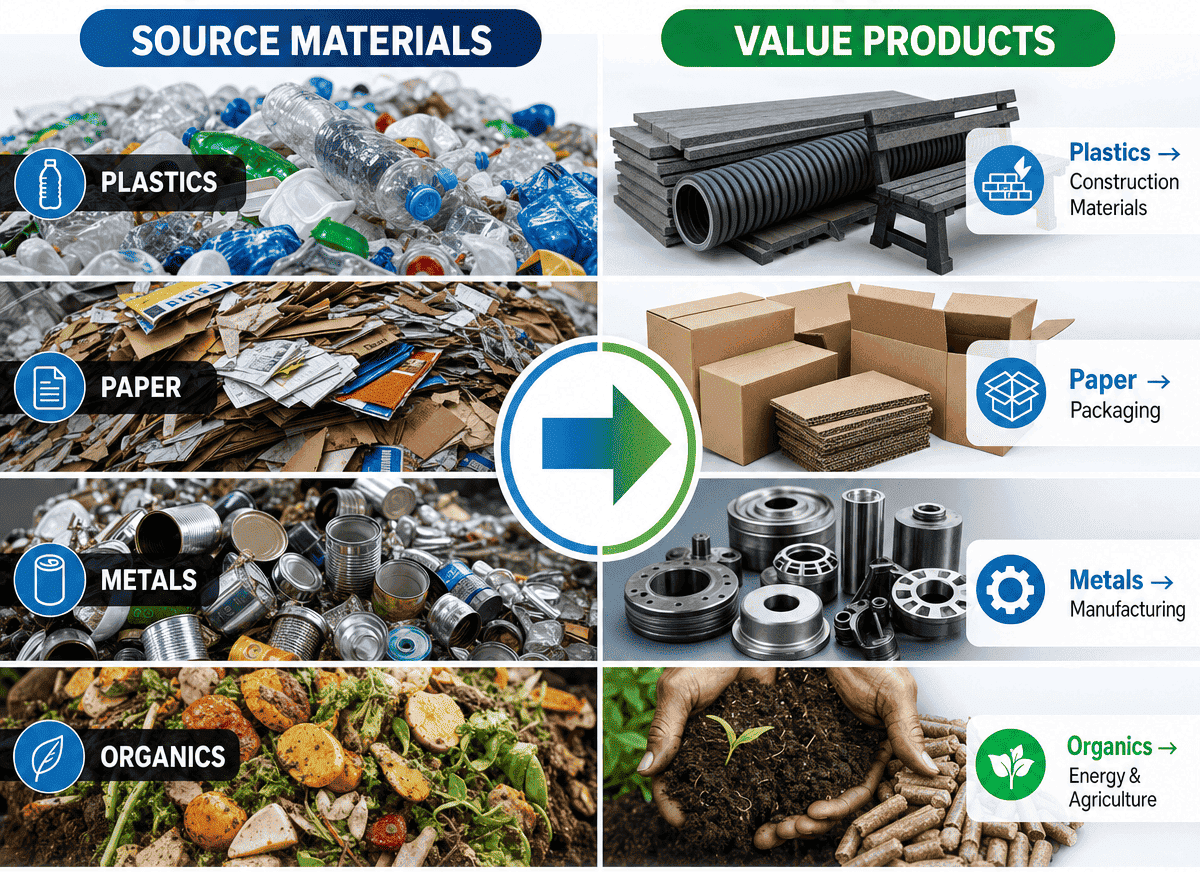
What Are Recycled MSW Materials Used For?
Recycled Plastics
Used in:
- Plastic products
- Packaging materials
- Construction materials
Recycled Paper
Used to manufacture:
- Cardboard
- Tissue products
- Packaging paper
Recycled Metals
Used in:
- Automotive manufacturing
- Construction
- Industrial production
Compost and Biogas
Used for:
- Agriculture
- Renewable energy generation
RDF Fuel
Used as an alternative fuel in industrial applications.

Key Benefits of MSW Recycling

Reduced Landfill Waste
Recycling significantly decreases landfill volumes.
Resource Conservation
Valuable materials remain in circulation.
Lower Environmental Impact
Reduces pollution and greenhouse gas emissions.
Energy Recovery
Converts waste into usable energy resources.
Circular Economy Support
Promotes sustainable resource utilization.
Common Challenges
Mixed Waste Streams
Poor source separation reduces recycling efficiency.
Contamination
Food residues and non-recyclable materials affect recovery rates.
High Transportation Costs
Long-distance waste transportation increases operating costs.
Variable Waste Composition
Waste characteristics differ by region and season.
Solutions
Advanced Sorting Technology
Improves material recovery rates.
Industrial Shredding Systems
Enhances waste preparation and processing efficiency.
Automated Recycling Facilities
Reduces labor requirements and increases throughput.
Integrated Waste Management
Combines recycling, RDF production, and energy recovery.
Typical Equipment Used in MSW Recycling
Process | Equipment |
Collection | Waste Collection Vehicles |
Sorting | Trommel Screen, Optical Sorter |
Shredding | Single Shaft Shredder |
Crushing | Industrial Crusher |
Metal Recovery | Magnetic Separator |
RDF Production | RDF Processing Line |
Energy Recovery | Waste-to-Energy System |
Conclusion
Municipal solid waste is not simply garbage—it is a valuable resource stream containing recyclable materials, organic matter, and energy-rich components. Through effective collection, sorting, recycling, and energy recovery processes, MSW can be transformed into reusable products, alternative fuels, and renewable energy. Modern recycling technologies play a vital role in reducing landfill dependency and supporting circular economy objectives.
Streamline Eco Tech Solution
Streamline Eco Tech provides equipment and integrated solutions for municipal solid waste processing and recycling.
Our systems include:
- Single Shaft Shredders
- Double Shaft Shredders
- Industrial Crushers
- RDF Production Lines
- Waste Sorting Systems
Related Resources:
https://slecotech.com/product/single-shaft-shredder/
https://slecotech.com/product/double-shaft-shredder/
Streamline Eco Tech helps waste management companies improve material recovery, increase processing efficiency, and maximize resource utilization.
Frequently Asked Questions
What are the main steps in plastic recycling?
Collection and sorting, size reduction (shredding then granulating), washing, separation by density/type, drying and finally pelletising or direct reuse as regrind.
Why shred plastic before washing?
Shredding increases surface area and unlocks trapped contaminants, making washing and separation far more effective and raising final flake purity.
What is regrind and how is it used?
Regrind is the uniform flake produced by a granulator from clean plastic scrap. It is fed straight back into extrusion or blending, closing the loop on in-house scrap.