
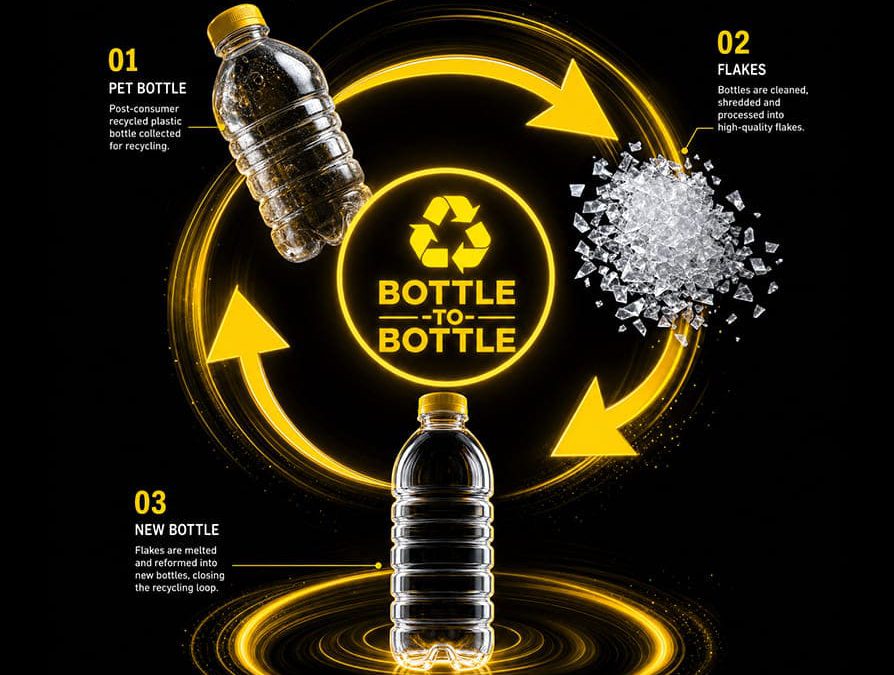
High-quality PET flakes are produced through a series of mechanical and washing processes that remove labels, caps, metals, PVC, adhesives, organic contaminants, and moisture from post-consumer PET bottles. A complete PET bottle washing line typically includes bale breaking, sorting, delabeling, crushing, float-sink separation, hot washing, friction washing, rinsing, dewatering, and drying. For bottle-to-bottle recycling applications, PET flakes generally require PVC content below 50 ppm, moisture below 1%, and label contamination below 100 ppm. Proper equipment configuration and process control are essential for achieving food-grade or high-purity recycled PET.
What Are High-Quality PET Flakes?
High-quality PET flakes are clean, dry, and contamination-controlled recycled PET materials suitable for reprocessing into new products.
PET flakes are produced by processing used PET bottles through shredding and washing systems. Their quality directly affects extrusion performance, IV stability, pellet quality, and end-product applications.
Typical applications include:
- Bottle-to-bottle recycling
- Polyester fiber production
- PET sheet manufacturing
- Food-grade rPET production
- Strapping and packaging materials
Typical Quality Standards for PET Flakes
| 参数 | High-Quality Standard |
| PVC Content | < 50 ppm |
| 水分含量 | < 1% |
| Label Content | < 100 ppm |
| Metal Content | < 20 ppm |
| PE/PP Contamination | < 200 ppm |
| Bulk Density | 0.25–0.40 g/cm³ |
| Flake Size | 12–16 mm |
How Does a PET Bottle Washing Line Work?
Each processing stage removes a specific type of contamination to improve PET flake purity.
Step 1: Bale Breaking
Compressed PET bottle bales are loosened to ensure consistent material feeding.
Equipment:
- Bale Breaker
- Feeding Conveyor
Purpose:
- Separate compacted bottles
- Improve sorting efficiency
Step 2: Pre-Sorting
Foreign materials are removed before size reduction.
Common contaminants:
- PVC bottles
- 金属
- 玻璃
- 论文
- Non-PET plastics
Equipment:
- Sorting Platform
- Optical Sorting System
- Metal Detector
Step 3: Delabeling
Labels are one of the largest contamination sources in PET recycling.
A high-efficiency delabeler can achieve:
- 90–98% label removal rate
Benefits:
- Lower glue contamination
- Reduced washing load
- Higher flake purity
Step 4: Crushing
PET bottles are reduced into uniform flakes.
典型输出大小:
- 12–16 mm
Equipment:
- Wet Crusher
- PET Crusher
Benefits:
- Increased surface area
- Improved washing performance
Step 5: Float-Sink Separation
Density separation removes polyolefin contamination.
Material behavior in water:
| 材料 | 密度 | 结果 |
| 聚丙烯 | 0.90 克/立方厘米 | 浮动 |
| PE | 0.92–0.96 克/立方厘米 | 浮动 |
| PET | 1.34–1.39 克/立方厘米 | 水槽 |
| PVC | 1.30–1.50 克/立方厘米 | 水槽 |
The system separates: PET flakes, Bottle caps, Rings, Residual labels
Step 6: Hot Washing
Hot washing removes adhesives, oils, and organic contaminants.
Typical operating parameters:
| 参数 | 范围 |
| 水温 | 80–95°C |
| 保留时间 | 15–30 分钟 |
| Caustic Soda | 1–2% |
Benefits:
- Remove glue residue
- Eliminate oil contamination
- Improve flake cleanliness
Step 7: Friction Washing
High-speed mechanical friction removes:
- Fine dirt
- Label residue
- 有机污染物
Typical rotor speed:
- 800–1200 rpm
Step 8: Rinsing and Neutralization
Clean water removes residual chemicals from the washing process.
Objectives:
- Reduce alkalinity
- Improve flake quality
- Meet downstream processing requirements
Step 9: Dewatering and Drying
Final moisture reduction is critical.
Equipment:
- 离心脱水机
- Thermal Drying System
Target moisture:
- 低于 1%
- Food-grade systems often achieve below 0.5%
Key Factors Affecting PET Flake Quality
Contamination control is more important than washing intensity alone.
Major Quality Risks
| Contaminant | 影响 |
| PVC | PET degradation |
| 金属 | Equipment damage |
| 标签 | 黑色斑点 |
| 粘合剂 | 凝胶形成 |
| 湿度 | Hydrolysis |
| Organics | 异味问题 |
Common Problems and Solutions
Problem 1: Excessive Label Content
Cause
- Inefficient delabeling
解决方案
- Upgrade delabeler rotor design
- Increase label removal efficiency
Problem 2: High Moisture Content
Cause
- Insufficient drying capacity
解决方案
- Add thermal drying stage
- Optimize dewatering speed
Problem 3: PVC Contamination
Cause
- Poor manual sorting
解决方案
- Install optical sorting equipment
- Improve inspection procedures
Problem 4: Low Flake Purity
Cause
- Inadequate washing process
解决方案
- Increase hot washing retention time
- Optimize friction washing parameters
PET Bottle-to-Bottle Recycling Process Flow
PET Bottle Bales ➡ Bale Breaking ➡ Sorting ➡ Delabeling ➡ Crushing ➡ Float-Sink Separation ➡ Hot Washing ➡ Friction Washing ➡ Rinsing ➡ Dewatering ➡ Thermal Drying ➡ High-Quality PET Flakes
常见问题
What moisture level is required for PET flakes?
Most PET recyclers target moisture below 1%. Food-grade applications often require below 0.5%.
Can PET bottle caps be recycled together with PET bottles?
Yes, but they must be separated during float-sink separation because PE and PP have lower densities than PET.
Why is PVC contamination dangerous?
Even small amounts of PVC can cause PET degradation during extrusion and significantly reduce product quality.
理想的 PET 片材尺寸是多少?
Most PET washing lines produce flakes between 12 mm and 16 mm for optimal washing and reprocessing performance.
流线型生态技术 解决方案
Streamline Eco Tech specializes in PET bottle recycling equipment and complete PET washing line solutions. Our systems integrate bale breakers, label removers, sorting platforms, crushers, float-sink separation tanks, hot washing units, dewatering machines, and drying systems to produce high-purity PET flakes for bottle-to-bottle recycling, fiber production, and other circular economy applications. Equipment configurations can be customized according to material conditions, contamination levels, and production capacities ranging from 500 kg/h to 6000 kg/h.